BHHS Team 9A has new math units under way! The Algebra classes have extended their investigations of linear functions to include inequalities. Algebra students are solving and graphing inequalities of both one and two variables. Students summative assessments from writing linear functions were impressive. Now the Algebra students will are preparing for the summative assessment for the inequalities unit with applications, which will be December 18. Keep up the good work!!
Our geometry students have focused on communicating with our mathematical language all semester. They are really putting their communication skills to use while writing PROOFS!! In our study of triangles, we are applying theorems with calculating angle measurements of interior and exterior angles . It contains lots of Algebra including factoring, which will benefit the students when they enter Algebra 2 next year. Writing the proofs has been a nice culmination of communicating with our "mathematical language". We are all impressed by the great work by Team 9A math students!!!

Here at Bloomfield Hills High School, we'd love to share what we've been up to in Learning Community 9A. We look forward to sharing our students' explorations in English, Math, Social Studies, and Science!
Wednesday, December 9, 2015
Sunday, December 6, 2015
Bacteria and Viruses and Diseases. OH MY!

 Biology students were still finishing up their Ecology Projects last week. Students researched various topics of their choice such as, "How has the decline of the bee population affected the ecosystems in Michigan?" and "How do factory farms impact the environment?" The classes have enjoyed hearing about all of the local and global environmental issues that scientists are currently working on.
After Thanksgiving break we began a new unit on populations. After introducing students to population characteristics such as density, spatial distribution (patterns in spacing) and growth, students are now digging deeper into the concept of how populations are limited by certain factors such as predator-prey relationships and disease. There isn't a better way to talk about bacterial and viral diseases but to look up close at those tiny bacteria through a microscope!
This week students are working through a discovery lab, where they learn the functions of each part of the microscope and how to focus it properly.
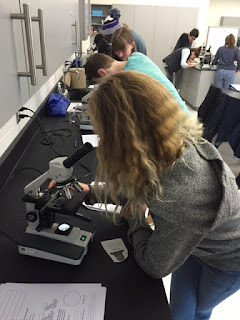 After practicing this lab technique, they will have a chance to focus in on the details of several types of bacteria to view the different shapes that bacteria takes. They will also view penicillin, a type of antibiotic, and learn how an antibiotic works as well as the problems associated with antibiotic resistance.
 After practicing this lab technique, they will have a chance to focus in on the details of several types of bacteria to view the different shapes that bacteria takes. They will also view penicillin, a type of antibiotic, and learn how an antibiotic works as well as the problems associated with antibiotic resistance.

Wednesday, November 18, 2015
Historical Fiction Unit Kick-Off in Mrs. Teal's Writ Lit I
 |
| Jade opens her copy of Nobody's Slave |
 We are now well under way in our novels. Each day, students have 30 minutes of class time to enjoy reading their books. As they go, students sticky-note their thoughts, observations about the characters, and questions about historical references. On any given day, students can be found reading in various spots around the room. Students have also been categorizing their sticky notes as literal, inferential, or critical, helping them to better understand the different levels of thinking involved when we interpret texts.
The second part of each class period is giving students time to build a warehouse of resources that help them understand the historical context of their novels, events they are/will be studying in World History. So far, students have looked at websites, YouTube videos, and scholarly articles. They'll be looking at artwork from this time period after Thanksgiving!
The last two weeks have been so exciting. There is great energy in a room full of readers, even when no one is speaking!
Friday, November 13, 2015
Using detailed documents to spark interesting research questions:
One area of focus in Freshman World History is giving students opportunities to formulate their own research questions. Many students at the freshman level have little experience with this task and are surprised at how difficult it is to come up with a good question. Good questions are generally relevant to the document, focused, and feasible to answer.
For this activity, we used a very detailed map of Germanic migrations and conquests (150 - 1066). The students were placed in groups of 5-6 and spent a length of time "close reading" the document. They were asked to try and notice everything on the map. They needed to gain an understanding of how the provided key was organized and used and then familiarize themselves with the movements of the various groups.
Each group was then asked to discuss the map together and brainstorm a variety of questions that this map could generate. Upon choosing a question that they believed met the criteria provided, they then wrote a hypothesis concerning their question, listed all clues they could find on the map, and began searching for quality sources that could help them discover the answer to the question that they asked.
When they returned the next class period, students were expected to have their question fully researched and answered (if possible) along with properly cited sources (MLA format). We took time sharing out some of the questions and the answers that they found. Here are some of the questions the students came up with;
Why did some Germanic Tribes migrate and some did not? ~ Justin Y.
Can I make a better / easier to read map than the one shared with us? ~ Truman G.
Why did the Vandals split into so many areas from Carthage in 429 C.E.? ~ Evan O.
Which of these tribes most influenced modern times? ~ Sherine S.
How was religion affected by the movement of Germanic tribes throughout Europe? ~ Samhita S.
After sharing out, the students were given time to write a reflection on the process of creating a quality research question and finding credible sources. This activity will hopefully aid the students in deciding on what adjustments they may need to make in their research process as they begin reading their historical fiction novel in Mrs. Teal's class. As they read their novel, they will be asked to create a variety of questions and find credible sources related to these questions creating as a final product an Annotated Bibliography.

Monday, November 2, 2015
Geometric Constructions and Algebra Linear Functions Lead our Mathematics early this year...
 |
| Math Advertisement with Geometric Constructions |
Algebra students dive deeper into their study of linear functions. This includes multiple ways of graphing, domain, range, ,intercepts, slope, and applications. The Algebra assessment also included a project where students had to justify their choice of method for graphing, while describing key features, then presenting it to to others. The written exam part of the Algebra assessment is also challenging and encompasses all the concepts and applications.
This school year has already been enriching in all aspects of the mathematics and applications that we have studied.
Friday, October 30, 2015
The Bone Collectors

Biology students have been studying ecology, particularly how energy flows through an ecosystem. Students used ecological pyramids to look at the different interactions between organisms.
 The highlight of learning about food webs was the dissection of owl pellets, or as Mrs. Novak likes to say, "barf balls". The students worked hard on separating fur from the bones of small rodents that a barn owl had preyed upon.

 |
Here is an example of bones one group found in an owl pellet. Finding skulls was the best!
After collecting the bones in the owl pellet, students could identify the type of rodent the owl most likely ate, use additional background information to produce a model of a food web, and calculate the pyramid of biomass and numbers.

Monday, October 26, 2015
Genius Hour with #tealsteachers
In LC 9A, we strive to give students a wide range range of learning activities every day. As one method of achieving this goal, I save 1 out of every 5 class periods for Genius Hour. A movement inspired by Google's 20% time and Daniel Pink's best-selling book Drive, Genius Hour gives students the chance to explore their passions and allows them choice in what and how they learn. To prepare for Genius Hour, students first read about the brain and curiosity in “Curiosity: It Helps Us Learn, But Why?” on nprEd.
 |
| Taylor W is reading Into the Wild to learn about Christopher McCandless |
And then, students began exploring. They asked questions, searched for answers, collaborated, and problem-solved!
 |
| Madison P is researching J.K. Rowling |
3 Genius Hour periods later, students have now put together brief Google Slides presentations to share their 1st quarter learning with their classmates. Jenna M decided to learn about Madam C.J. Walker, the first female self-made millionaire, while Ethan S read up on Jimi Hendrix. Finding their curiosity piqued by other interests, Forest Z challenged himself with chess, and Jonathan M dove into black holes.
 |
| Carlo B reflects on his resources |
 |
| Zain K reflects on his learning |
Ask your student to show you his or her Genius Hour presentation.... and don't be surprised if you learn something new!
Subscribe to:
Posts (Atom)